
Royal Rehab
Health & Wellness Blogs
Expert advice, practical recovery tips, and evidence-informed guidance to help you move better, feel stronger, and take control of your health.
Sciatica Explained: Why That Shooting Leg Pain Won’t Go Away (And What Actually Helps)
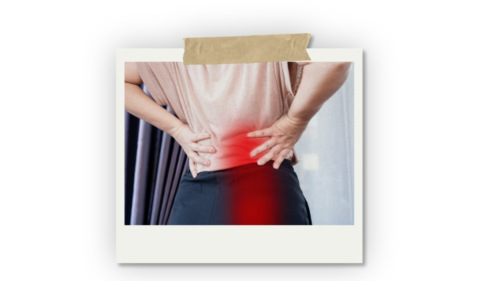
You bend down to tie your shoe and a jolt shoots from your lower back straight down your leg. Or maybe it’s a dull, burning ache that’s been sitting in your buttock for three weeks, making it hard to sit through a meeting or sleep past 2 a.m.
That’s sciatica, and if you’re reading this, there’s a good chance you’re dealing with it right now.
Here’s the part most people don’t realize: sciatica isn’t actually a diagnosis on its own. It’s a symptom — a signal that something is irritating or compressing the sciatic nerve, the longest and widest nerve in your body. Figuring out why that nerve is irritated is the difference between temporary relief and lasting recovery.
This guide walks through what’s really happening when sciatica flares up, what causes it, how it’s diagnosed, and which treatments are backed by evidence, not just internet myths.
If you’re in Oakville, Burlington, Milton, or the Bronte and West Oak Trails area, we’ll also touch on when it’s time to bring in a professional.
What Is Sciatica, Really?
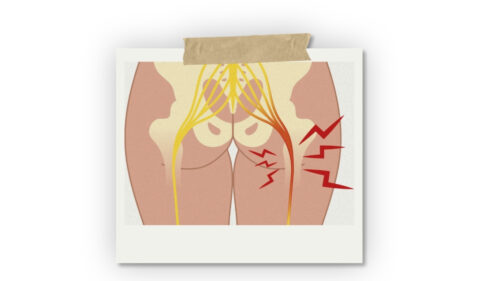
The sciatic nerve forms from five nerve roots that exit your lower spine, merge into one thick nerve roughly the width of your thumb, and travel through your buttock, down the back of your thigh, and branch out below the knee into your calf and foot.
When something compresses, pinches, or inflames any part of that pathway, you feel it — but not always where the problem started. This is why someone can have a bulging disc in their lower back and feel the pain mostly in their calf.
Common sciatica symptoms include:
- Sharp, shooting, or burning pain down one leg
- Numbness or tingling in the leg or foot
- A dull ache in the buttock that worsens with sitting
- Muscle weakness in the leg or foot
- Pain that worsens when coughing, sneezing, or sitting for long periods
- Pain that’s often worse on one side of the body
Sciatica can range from a mild nuisance to pain severe enough to disrupt walking, working, and sleeping. According to the Cleveland Clinic, symptoms can range from mild to severe, with the most severe cases making it hard to move.
What Causes Sciatica?
Sciatica develops when a structure near the sciatic nerve pathway starts pressing on it or irritating it through inflammation. The most frequent causes include:
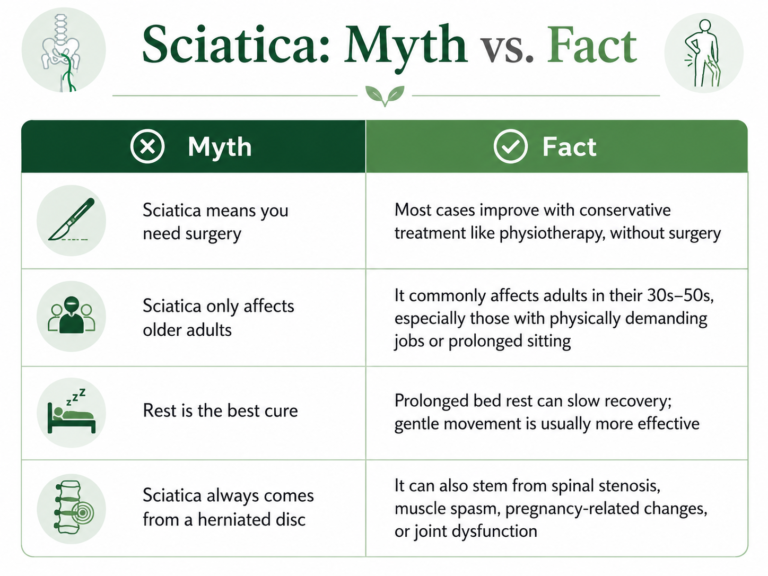
- Herniated or bulging disc — The soft, gel-like center of a spinal disc can push through its outer layer and press on a nearby nerve root. This is the most common cause of sciatica in people under 50.
- Spinal stenosis — A narrowing of the spinal canal, often related to age-related changes, that reduces the space available for nerve roots.
- Piriformis syndrome — The piriformis muscle sits deep in the buttock, close to the sciatic nerve. When it tightens or spasms, it can compress the nerve and produce sciatica-like symptoms even when the spine itself is healthy.
- Degenerative disc disease — As discs lose height and hydration over time, the space nerves travel through can become tighter, increasing the chance of irritation.
- Spondylolisthesis — This occurs when one vertebra slips forward over the one below it, which can pinch nerve roots as they exit the spine.
- Pregnancy-related changes — Hormonal changes that loosen ligaments, combined with added weight and a shifted centre of gravity, can put pressure on the lower spine and sciatic nerve.
Risk factors that make sciatica more likely include:
- Jobs involving heavy lifting, twisting, or prolonged driving
- Prolonged sitting (desk jobs, long commutes)
- A sedentary lifestyle combined with weak core and hip muscles
- Obesity, which adds load to the spine
- Diabetes, which can affect nerve health over time
- Previous back injuries

How Is Sciatica Diagnosed?
You don’t necessarily need an MRI to get a sciatica diagnosis started. A skilled clinician can often identify the likely cause through a detailed history and hands-on assessment, which typically includes:
- Movement and posture assessment, to see what positions ease or worsen symptoms
- Neurological testing — reflexes, strength, and sensation in the leg
- The straight-leg raise test, which reproduces sciatic symptoms when the nerve is irritated
- Palpation of the lower back, hip, and buttock muscles
Imaging such as an X-ray, MRI, or CT scan is usually reserved for cases involving red flags — significant weakness, loss of bladder or bowel control, unexplained weight loss, or symptoms that don’t improve after several weeks of conservative care. Physical therapy guidelines generally discourage routine imaging for low back pain and sciatica, since it often doesn’t change the recommended treatment approach.
Quick Tip: If your pain is worse when sitting and better when walking or lying down, this often points toward a disc-related cause. If it’s the opposite — worse with walking, better with sitting — this can point toward spinal stenosis. This isn’t a diagnosis on its own, but it’s useful information to share with your therapist.
Treatment Options That Actually Work
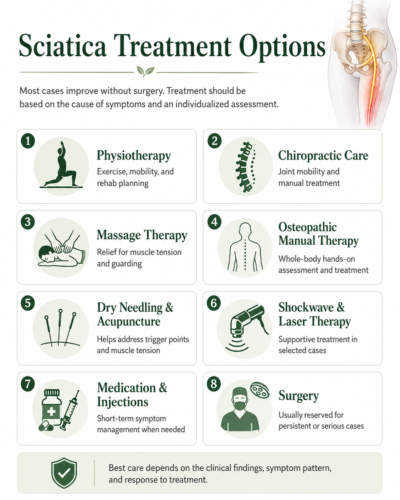
The good news: most sciatica resolves without surgery. Research consistently supports an active, progressive approach over prolonged rest.
Physiotherapy — A physiotherapist builds a plan specific to the underlying cause, not just the symptom. This might include manual therapy to improve joint mobility, nerve gliding exercises, core and hip strengthening, postural retraining, and graded activity plans that rebuild tolerance to walking, standing, and lifting.
Chiropractic care — Spinal adjustments can help restore mobility to restricted joints in the lower back, which may reduce nerve irritation for certain types of sciatica, particularly when joint stiffness is a contributing factor.
Massage therapy — Deep tissue and trigger point techniques can relieve tightness in the piriformis and surrounding muscles, which is especially useful when muscle spasm is compressing the nerve.
Osteopathy — An osteopathic manual practitioner takes a whole-body view, assessing how the spine, pelvis, hips, and even breathing mechanics work together. Gentle joint mobilization, soft tissue release, and myofascial techniques can ease the mechanical restrictions contributing to nerve irritation, often complementing physiotherapy or chiropractic care rather than replacing it.
Dry needling and acupuncture — Both approaches target trigger points and tight muscles that can refer pain along the sciatic pathway, offering another tool for symptom relief alongside active rehabilitation.
Shockwave and laser therapy — These modalities can support tissue healing and reduce inflammation in some presentations, typically used alongside hands-on treatment and exercise rather than as a standalone fix.
Medication and injections — Anti-inflammatory medication, prescribed by a physician, may help in the acute phase. In more persistent cases, a doctor may recommend an epidural steroid injection. These are typically used to manage pain while active rehabilitation continues, not as a replacement for it.
Surgery — Generally considered only after conservative treatment hasn’t helped over several months, or if there are significant neurological red flags like progressive weakness or loss of bladder/bowel control. Mayo Clinic notes that most people with sciatica improve with nonoperative treatment, and only a small number end up needing surgery.
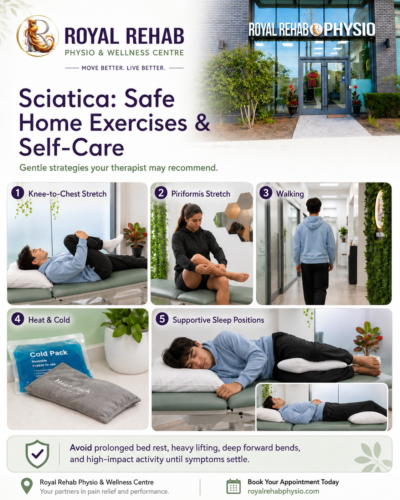
Safe Home Exercises and Self-Care
A proper assessment matters for lasting results, but these gentle strategies can help in the meantime:
- Knee-to-chest stretch — Lying on your back, gently pull one knee toward your chest. Hold 20–30 seconds. This can ease pressure on the lower spine.
- Piriformis stretch — Sitting in a chair, cross the affected ankle over the opposite knee and gently lean forward. This targets a common source of nerve compression.
- Walking — Short, frequent walks keep blood flow moving and prevent the stiffness that comes from too much rest.
- Alternating heat and cold — Cold can calm acute inflammation in the first 48 hours; heat can help relax tight muscles afterward.
- Supportive sleep positions — Sleeping on your side with a pillow between your knees, or on your back with a pillow under your knees, can reduce strain on the lower back overnight.
What to avoid: Prolonged bed rest, heavy lifting, deep forward bends, and high-impact activity until symptoms start to settle. These can aggravate an irritated nerve rather than help it calm down.
What’s a Realistic Recovery Timeline?
Recovery depends heavily on the underlying cause, but general patterns include:
- Acute phase (0–2 weeks): Pain is often at its worst; the priority is calming irritation and maintaining gentle movement.
- Subacute phase (2–6 weeks): Most people see noticeable improvement as inflammation settles and mobility work begins.
- Rehabilitation phase (6–12 weeks): Focus shifts to strengthening, correcting movement patterns, and preventing recurrence.
- Beyond 12 weeks: Persistent symptoms at this stage usually warrant a more thorough reassessment, possibly including imaging.
Many people notice meaningful improvement within four to six weeks of starting a structured treatment plan, though nerve-related pain can sometimes take longer to fully settle compared to muscular pain, since irritated nerves tend to heal more slowly than muscle tissue.
When to Seek Professional Help ?
Most sciatica cases are manageable with conservative care, but seek prompt medical attention if you experience:
- Sudden, severe weakness in the leg or foot
- Loss of bladder or bowel control
- Numbness in the groin or inner thighs (saddle anesthesia)
- Pain following a significant trauma, like a fall or car accident
- Symptoms that are getting progressively worse rather than better
- Pain that hasn’t improved after several weeks of self-care
These can be signs of a more serious condition, such as cauda equina syndrome, which requires urgent medical attention.
For everyone else, earlier is generally better. Waiting weeks or months to seek treatment can allow muscle guarding and movement compensations to set in, making recovery take longer.
Preventing Sciatica From Coming Back
Once symptoms settle, prevention becomes the priority:
- Strengthen your core and glutes — these muscles support and stabilize the lower spine
- Move throughout the day — set a timer to stand and walk every 30–45 minutes if you sit for work
- Lift with your legs, not your back — bend at the hips and knees, keep the load close to your body
- Maintain a healthy body weight to reduce spinal load
- Stay active with low-impact exercise like swimming, walking, or cycling
- Address tight hips and hamstrings with regular stretching
Staying physically active and avoiding prolonged inactivity is consistently linked to better outcomes for people managing back and nerve-related pain, which lines up with what we see clinically: patients who stay engaged in movement, guided appropriately, tend to recover more fully and with fewer flare-ups.